3 Things That Embarrass Dog Owners

by Wayne Booth on June 14, 2010

We all want to be proud of our dogs. That’s one of the reasons we get a dog. We love them and they become almost like a child in some cases. You can see bumper stickers that say “My Dog Is Smarter Than Your Honor Student.” How embarrassing is it then when your dog does something that makes you want to crawl into a hole? You’ve been telling people how smart, how cute, how wonderful your dog is and as soon as they see your dog he does something you hate.

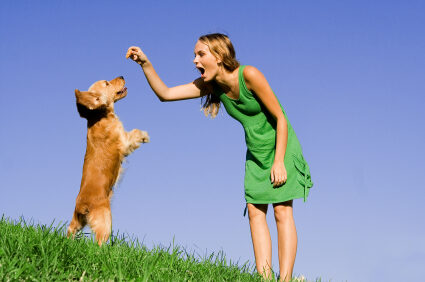
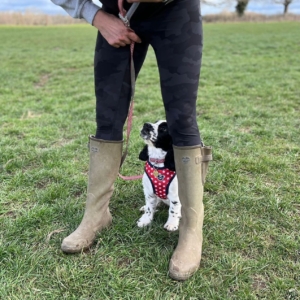
1. Jumping on people. One of the embarrassing things some dogs do is jumping on people. Whether you’re out for a walk or your dog jumps on people when they walk in your door, this is embarrassing behavior. It’s a clear sign that your overly-enthusiastic dog seems to be out of control.

What can you do to stop the jumping behavior? One of the best things you can do to head off jumping behavior is teach your dog the Sit command when she is preparing to jump. It’s best to practice this in a confined area at first. Practice when it’s just you and your dog. Make sure he already knows Sit. When he starts to jump on you tell him to Sit. Depending on how excited he is it may take a few tries to get this right but it will work. Make sure you praise him and give him a reward he really enjoys, whether it’s treats, a favorite toy or lots of petting and attention.

Once your dog is reliably sitting when he starts to jump on you, you can practice having a friend or family member ring your doorbell or knock on your door. Your dog may get very excited again and prepared to jump on them when they enter. Practice having him sit before opening the door. Again, this may take some practice but your dog should get the idea that he is supposed to sit instead of jump. If nothing else, he should be responding to your command to Sit.

Eventually you will move on to the hardest part — teaching your dog to politely sit when he has the urge to jump up on someone he meets in the street or elsewhere. This is an uncontrolled situation so you should always have your dog leashed when you’re out. Make sure that your dog gives you a perfect Sit at home when he has the urge to jump before you try this outside your home.

2. Lunging at Dogs. It’s very embarrassing, not to mention rather dangerous, to have your dog lunging at other dogs when you’re out for a walk. The best way to prevent this problem is by making sure that you socialize any puppy well from an early age. However, if you have a dog that is already lunging at other dogs or people, it’s a little late for socialization. You need to take steps to keep your dog from hurting anyone. You may want to consider whether you should be walking your dog in public and whether you are able to control him.

You should consider whether your dog could have any kind of veterinary condition causing him to lunge or behave aggressively toward others. Your vet may be able to find a physical cause for your dog’s behavior. If not, then you need to consider possible behavioral problems. If your dog lunges at other dogs (or people) on an ongoing basis then you may wish to ask your vet to recommend a dog behaviorist. They may be able to work with your dog and find the problem.

There are some things you can do yourself if your dog lunges at other dogs. Consider a properly fitted muzzle or head collar. A head collar such as a Halti or Gentle Leader is not a good choice for every dog but it does give added control over dogs that lunge and pull their owners. You should be careful about possible neck injuries to your dog when he’s wearing a head collar.

Avoid walking where there may be loose or stray dogs. Your lunging dog doesn’t need an added reason to pull on the leash.

Walk your dog in quiet neighborhoods and more controlled settings.

3. Constant Barking. One thing that frequently embarrasses people with their neighbors is a dog that barks constantly. If your dog is a nuisance barker and you’re outside yelling at him to shut up, the neighbors can become annoyed with both of you very quickly, especially when they’re trying to sleep.

Dogs often bark because they are bored, lonely or frustrated. But there are some dogs that seem to bark to hear the sound of their own voice. The best advice to deal with barking dogs is to make sure that all of their needs are being met on a regular basis. Take away their reasons to bark. Make sure that your dog gets lots of exercise — tired dogs take naps. Make sure that your dog has plenty of fun toys. And, very importantly, spend time training your dog. Obedience training can help keep a dog mentally fit — the opposite of boredom. Spending time training your dog also means that you’re spending time together. When your dog is having all of his needs met he will, hopefully, have less to bark about.

If your dog still stands in the backyard and barks at least he will have had a little obedience training. When you tell him to “Come!” you have a better chance of him actually obeying you and coming inside where he will be quiet.

Simply stated these bad behaviors can all be cured with some good dog training. So call a trainer in your area and train that dog!

Until next time…..

{ 1 comment }

Training Your Dog To Stay In The Yard

by Wayne Booth on June 7, 2010

People and dogs are alike in the sense that they both are somewhat territorial. Your dog probably has a good idea of the concept of your “property” or your area of the street or neighborhood. He knows where home is, especially if he spends much time outside. If another dog walks into your front yard, your dog will likely have something to say about it. However, that doesn’t mean that your dog will understand the concept of staying in the yard. It is never easy to train your dog to stay in the yard. Anyone who tells you otherwise doesn’t know much about dogs.

Most dogs have a natural urge to roam, whether they are spayed/neutered or intact. Dogs are highly social animals, as well as being very curious. They like to explore. That means that if your dog is outside it’s very likely that he will soon be out of your yard. He may hang “around” your yard, meaning that he comes and goes. He may go up and down the street. He may wander the neighborhood. He may not go too far away. But, left to his own devices, it’s unlikely that your dog will stay put in your yard.

You may attempt to train your dog to stay in your yard. You can do this by making sure that your dog knows basic obedience commands such as sit-stay and that he comes when called. Practice teaching him (in the house) that he is to respect the boundaries that you set. For instance, you can teach your dog not to bolt out the door. Teach him to halt and sit politely waiting for you to open the door and give him the go-ahead to go outside. However, it must be said that it’s unlikely that your dog will make any kind of connection between sitting and waiting for you to open the door for him and not crossing an imaginary line in your backyard.

You can leash your dog and walk around the boundaries of your yard, giving him short corrective jerks when he goes where he shouldn’t. Give praise when he stays within the boundaries. If you do this enough, and watch your dog like a hawk when he is alone in the yard, it is possible that you can prevent him from leaving the yard, but you will need to watch him constantly.

It is really not advisable to depend on your dog not leaving the yard without a fence. Virtually any dog will leave the yard unless you are standing over them watching them constantly. Even if you think your dog is trained not to leave the yard, it’s usually only a matter of time before something catches your dog’s interest and he leaves to investigate. Even an elderly dog will leave the yard at times. You can’t trust your dog not to leave the yard.

The only exception occurs when your dog has been trained to stay in your yard using an invisible fence. If you have an invisible fence then your dog has been taught to respect the boundaries of the yard and he will not usually attempt to cross them.

If, however, you simply try to teach your dog to stay in your yard, your dog will probably leave the yard at some point. Please make sure that your dog is wearing a collar with your name, address and phone number. A microchip is also advisable. Make sure that your dog is wearing his rabies tag and licenses. Better yet, look into getting a fence or an underground invisible fence.

If you are in the Nashville area and need an invisible fence give me a call, I have a great company for you to deal with.

Until next time…………………

{ 3 comments }

Is Your Dog Allergic To Mosquitoes?

by Wayne Booth on May 31, 2010

If you live in the Nashville area you know that we have an abundance of mosquitoes due to the flooding earlier this month.

Some dogs can be allergic to mosquitoes. However, it’s not always easy to know if this is what your dog is allergic to or not.

Mosquito bites on a dog generally look like lots of other insect bites. They may appear as a tiny bump. The bite may or may not get any larger. It may linger for a day or for several days.

However, if your dog is allergic to mosquito bites you can expect your dog to itch, to scratch at the bite, and even to bite at the spot, perhaps until it bleeds. The bites will usually look like lumps or welts if there is an allergic reaction.

To make a definite diagnosis of a mosquito allergy you need to take your dog to a veterinarian. There are several ways your vet can test to find out if your dog has an actual allergy. The most definitive way is by doing a blood test and sending it to a lab where they can match your dog’s blood to find out what he’s allergic to. This will give you a precise answer so you’ll know if your dog is really allergic to mosquitoes.

If you live in an area where mosquitoes are prevalent you will probably want to take some precautions for your dog. Advantix is available by prescription from your veterinarian. It’s a once-a-month topical to prevent fleas, ticks and mosquitoes. You can also use a flea spray that prevents mosquitoes along with the Advantix.

If your dog is having an allergic reaction to mosquito bites you will probably want to call your veterinarian, especially if this is the first time this has occurred. Your vet will probably advise you to give your dog an allergy medicine such as Benadryl but you will need to talk to your vet to find out the proper dosage for your dog’s weight and age.

If your dog has recurring reactions to mosquito bites your vet may recommend giving your dog a prescription allergy medication on a regular basis.

In addition to the agony of the allergic reaction, mosquito bites are dangerous to your dog because they can carry heartworm disease. It’s very important that you keep your dog protected against heartworm if you live in an area where you encounter mosquitoes. Heartworm disease is now found in all parts of the United States. It can be deadly if left untreated.

If you suspect that your dog is allergic to mosquitoes it’s best not to fool around with herbal remedies or so-called “natural” cures. These remedies have a doubtful track record and your dog is suffering. Talk to your vet and use the most effective preventives and treatments possible to make your dog feel better quickly.

Fortunately, most dogs are not allergic to mosquitoes and do not have a strong reaction to an occasional mosquito bite. If your dog does get a mosquito bite you probably won’t even know it. Keep your dog up-to-date on his heartworm medication and you shouldn’t have any problems from mosquitoes.

Until next time…….

{ 1 comment }

Does Tug-of-War Teach Aggression?

by Wayne Booth on May 24, 2010

Many people worry that if they play tug-of-war with their dog (or “tug”) that they will be teaching their dog to be aggressive. They’re afraid that playing tug with their dog can lead to problems with dominance. Are they right to be worried? Does tug-of-war teach aggression?

Actually, many recent studies have shown that dogs who enjoy rough house play with their owners were generally considered better socialized than dogs who didn’t. These dogs also had less separation anxiety. This included games of tug-of-war. These dogs were considered more confident without being “dominant” or “aggressive.” These studies did not find any connection between playing tug-of-war and developing aggression or dominance. (Rooney and Bradshaw, 2003; Goodloe and Borchelt, 1998) J. O’Heare, in Aggressive Behavior In Dogs (2007) writes: “The relationship between tug-of-war and dominance aggression appears to be a myth.” (Ottawa: DogPsych Publishing).

There is no reason why you shouldn’t enjoy playing tug-of-war with your dog as long as you establish the boundaries and control the game.

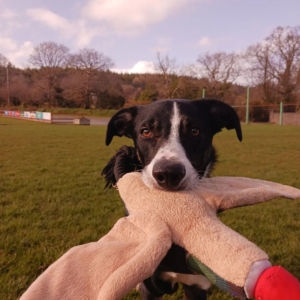
Choose a toy to use for playing tug-of-war. This should be a toy that will withstand some pulling and abuse since your dog will be using his teeth. Make sure not to use a sock or shoe. Even if you use an old sock or shoe your dog won’t be able to distinguish between an item you’ve discarded and one that you’re currently using.

You should always be the one to give the cue for starting a game of tug-of-war. Offer the toy to your dog and say something like, “Tug!” You may have to shake the toy in front of your dog a few times to get him to take it. Once your dog has the toy and is tugging you should enjoy the game for a few moments and then tell your dog to “drop it.” Keep your tone positive and upbeat. Make sure you praise and reward your dog for dropping the toy so he will be willing to drop it the next time you ask. Treats are good. You can also start another game of tug with him as a reward.

If your dog starts to get too worked up or excited with the game you should tell him to “drop it.” This keeps you in control of the game. Be sure to praise and reward your dog for dropping it. If your dog refuses to drop the toy you should simply drop your end of the toy and move away. Your dog can’t play without you. There is no tug unless you pull, too. You should always be the person in charge of when the game starts and stops.

Do remember to always praise and reward your dog for dropping the toy when you tell him to do so.

If your dog tries to take over the game or pesters you to play tug-of-war with him, you should ignore him. Wait until he is doing something else before you offer him the toy. The game should always be your idea, not his.

As long as you control the game you won’t ever have any problems with your dog becoming dominant or aggressive playing tug-of war. You set the boundaries and the rules.

BUT….I still believe that tug-of-war is not good for children and their dogs and can actually lead to some aggression toward the children.

Until next time……..

{ 1 comment }

Disaster In Nashville !

by Wayne Booth on May 3, 2010


It was a very tough weekend for those of us who call Nashville our home. Never in my wildest dreams did I think that the Cumberland River would over-spill its banks and into downtown streets and businesses, that the Opryland Hotel would have to be evacuated, or that hundreds of people would lose their homes to raging waters. Nashville saw first-hand what Mother Nature is capable of…and it wasn’t pretty.

Receiving over 15+ inches of rain in a relatively short period of time, communities all across Middle Tennessee struggled to keep water out of our homes, to keep our families and pets safe. Pictures of devastated neighborhoods stream across our TV screens, and until you actually see it with your own eyes, you cannot believe how bad it is.

My family and I are one of the lucky ones….our home was in a neighborhood that did not get any damage…we were only hindered by flooded streets when trying to leave our home. My heart goes out to all who weren’t as lucky…to those who are sifting through their belongings, trying to make sense of all the destruction.

Nashville’s citizens have a long-standing reputation for volunteering when the community calls. I urge you to help your neighbor, to lend a helping hand, to do what you can to help pull our great city through this crisis. I wish you a speedy recovery Nashville…

Until next time………..

Wayne Booth

{ 2 comments }

Dealing With An Overweight Dog

by Wayne Booth on April 26, 2010

It’s estimated that around 40 percent of the dogs in the United States are overweight or obese. Most of those dogs are overweight simply because their owners are feeding them too much food and the dogs don’t get enough exercise.

Most of us can’t stand for our dogs to be hungry. All it takes is for our dog to turn those big, pleading eyes on us and we get out the food bowl. But, realistically, it’s much healthier for your dog to maintain a healthy weight even if it means cutting back on the food.

If you have any doubts about whether or not your dog is overweight there are a couple of good ways to tell. First of all, most dogs should have a “waist.” That is, behind their ribcage, your dog should have a slight tuck up in his flank area.

Secondly, you should be able to not only find your dog’s ribs when you feel his sides, but you should be able to feel them. They should not be sticking out and he shouldn’t look skinny. But when you run your hands over your dog you should be able to feel the ribs. If you have to poke through several layers of flab to find your dog’s ribs then your dog is definitely overweight!

Third, when viewed from above, or from any other angle, your dog should not have a back like a table top. It shouldn’t be broad and flat. You shouldn’t be able to set a tray on your dog’s back.

And, fourth, you will know if your dog is overweight if he waddles when he walks or if he becomes tired easily when he exercises. Fit dogs should be able to take a moderately long walk without tiring or run and play without getting worn out quickly.

If your dog is overweight you can help your dog slim down by following some sensible diet suggestions.

1. Measure your dog’s food and feed him controlled portions. No free feeding or keeping food in the bowl 24/7. Check the dog food label and use it as a guideline for the amount that you should feed your dog. Feed your dog 1 meal a day or 2 times if it makes you feel better. If you feed twice a day simply divide the daily ration and feed it in two meals.

2. Cut out the snacks and treats, or at least change to healthy treats such as apples and carrots that won’t pile on pounds.

3. If your dog acts like he’s starving, add canned green beans to his meals. Green beans will add some bulk to your dog’s diet and help him feel fuller without adding a lot of calories.

4. Slowly start increasing your dog’s exercise. Start with short walks and gradually increase them to moderately long walks. As your dog loses weight he will probably start to feel more active.

If you follow these suggestions you can help your dog lose the extra weight and live a healthier life.

Until next time……..

{ 3 comments }